What is digital branding and why it matters for SMBs
Many small business owners believe digital branding and digital marketing are interchangeable terms. This confusion costs businesses dearly. Research shows that strong digital branding boosts revenue by 23% whilst also reducing customer acquisition costs significantly. Digital branding is the strategic foundation that shapes how customers perceive your business across every online touchpoint. This guide clarifies what digital branding truly means for small businesses, explains proven methodologies to build your brand identity, and shows you how to measure tangible results whilst avoiding costly mistakes.
Table of Contents
- Key takeaways
- Understanding digital branding fundamentals
- Key methodologies for building your digital brand
- Digital branding versus digital marketing: key differences
- Measuring impact and avoiding common pitfalls
- Take your digital branding to the next level with Digital Sphere
- Frequently asked questions
Key Takeaways
| Point | Details |
|---|---|
| Branding fundamentals | Digital branding is the strategic process of creating and maintaining a cohesive brand identity across online channels to build recognition, trust and long term relationships for small businesses. |
| Measurable benefits | Strong digital branding boosts revenue by 23 per cent and lowers customer acquisition costs for small firms. |
| Branding versus marketing | Branding focuses on relationships and identity while marketing concentrates on campaigns and transactions. |
| Core methodologies | Small firms should define brand foundation, develop visual identity, maintain consistency, create content pillars and measure results. |
Understanding digital branding fundamentals
Digital branding is the strategic process of creating, managing, and maintaining a cohesive brand identity across digital channels to build recognition, trust, and long-term customer relationships for small businesses. Unlike traditional branding confined to physical materials, digital branding encompasses every online interaction your customers have with your business. This includes your website design, social media presence, email communications, content tone, and even how quickly you respond to customer enquiries.
The scope extends far beyond simply having a logo and colour scheme. Digital branding shapes the entire customer experience from first discovery through to repeat purchases. Consider how customers form impressions when they visit your website, read your social posts, or receive your emails. Each touchpoint either reinforces or undermines the brand identity you’re trying to build.
Four core elements form the foundation of effective digital branding:
- Visual consistency across all platforms creates instant recognition and professional credibility
- Authentic brand voice that reflects your values and resonates with your target audience
- Strategic messaging that communicates your unique value proposition clearly and memorably
- Seamless user experience that makes every interaction intuitive and satisfying
Consistency matters more than perfection. When customers encounter the same visual style, tone, and messaging across your website, social channels, and communications, they develop trust. Inconsistency signals unprofessionalism and creates confusion about who you are and what you stand for. Research demonstrates that consistent branding increases revenue by making your business instantly recognisable in crowded digital spaces.
“Digital branding focuses on building relationships rather than transactions. It’s about creating emotional connections that transform one-time buyers into loyal advocates who actively promote your business.”
Small businesses often underestimate the strategic importance of digital branding. They rush into marketing campaigns without establishing a solid brand foundation. This approach wastes resources because marketing messages lack the cohesive identity needed to build lasting customer relationships. Strong digital branding amplifies every marketing pound you spend by ensuring your campaigns reinforce a consistent, memorable identity. When you invest in Digital Sphere solutions, you’re building this essential foundation that makes all subsequent marketing efforts more effective and efficient.

Key methodologies for building your digital brand
For small businesses, key methodologies include defining core brand identity, developing visual identity, maintaining consistency, creating content pillars, and measuring results through systematic implementation. Follow these five proven steps to establish a powerful digital brand that resonates with your target audience and drives measurable business growth.
- Define your brand foundation. Start by articulating your mission statement that explains why your business exists beyond making profit. Identify three to five core values that guide every business decision. Craft your unique selling proposition by pinpointing exactly what makes you different from competitors. Develop detailed audience personas including demographics, pain points, goals, and online behaviour patterns. This foundation informs every subsequent branding decision.
- Design your visual identity system. Create or commission a professional logo that works across all digital platforms and sizes. Select a primary colour palette of three to four colours that evoke the emotions you want associated with your brand. Choose two complementary fonts for headings and body text that reflect your brand personality. Document everything in a style guide that ensures consistency as your business grows. Visual identity extends beyond aesthetics to create instant recognition.
- Establish consistency across channels. Apply your visual identity and messaging guidelines to your website, social media profiles, email templates, and digital advertising. Ensure your brand voice remains consistent whether customers interact via Instagram, email, or your website. Consistency doesn’t mean repetition; it means maintaining recognisable patterns in how you communicate and present yourself. Regular audits help identify inconsistencies before they confuse customers.
- Develop strategic content pillars. Identify three to five content themes that align with your brand values and audience interests. Create an editorial calendar that balances educational content, behind-the-scenes glimpses, customer stories, and product information. Plan engagement strategies for each platform based on where your audience spends time. Content pillars give structure to your digital presence whilst allowing creative flexibility within defined boundaries.
- Measure and refine continuously. Track brand awareness metrics including website traffic, social media reach, and search volume for your brand name. Monitor engagement rates, sentiment analysis, and customer feedback across platforms. Use analytics to identify which brand messages resonate strongest and which channels drive most value. Quarterly reviews allow you to refine your approach based on real performance data rather than assumptions.
Pro Tip: Use free design tools like Canva to create professional brand assets without expensive design software. Their brand kit feature lets you save colours, fonts, and logos for consistent application across all materials.
Implementing these methodologies systematically builds a digital brand that attracts ideal customers and supports sustainable growth. Small businesses that rush this process often waste resources on marketing campaigns that fail because they lack coherent brand identity. Taking time to build proper foundations pays dividends through more effective marketing, stronger customer loyalty, and reduced acquisition costs. Optimising your Google Business Profile with consistent branding elements extends your professional identity into local search results where customers actively look for businesses like yours.
Digital branding versus digital marketing: key differences
Digital branding focuses on long-term perception and loyalty, whereas digital marketing prioritises short-term conversions and measurable ROI through tactical campaigns. Understanding this distinction helps small business owners allocate resources strategically and avoid the common mistake of jumping into marketing without establishing brand foundations.
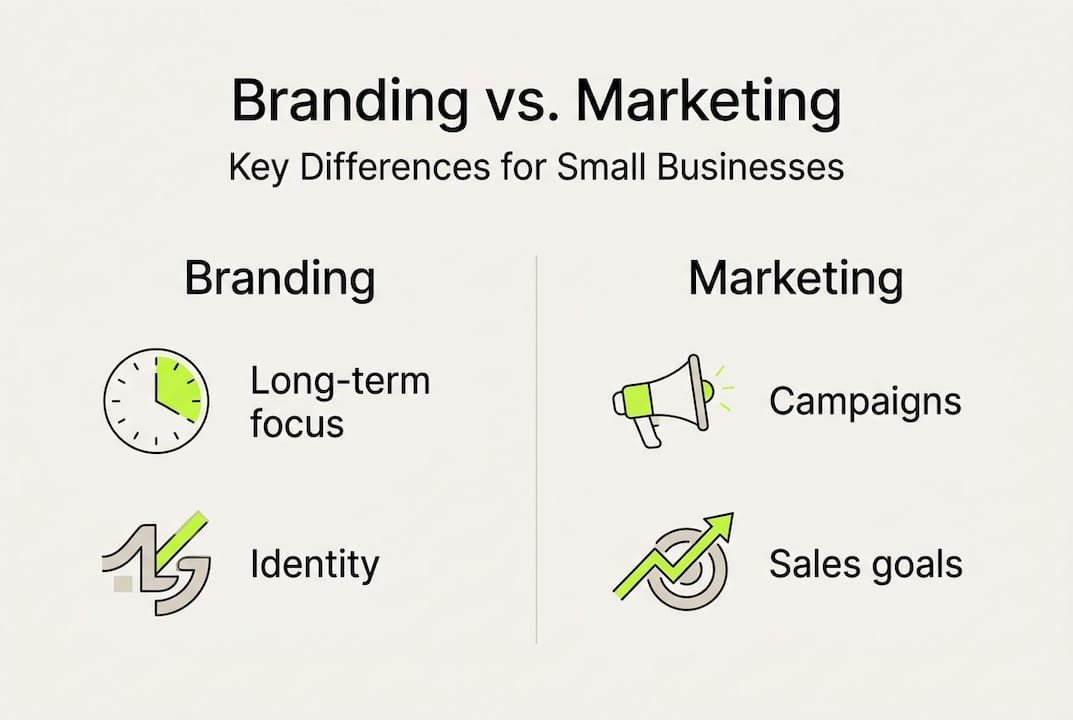
| Aspect | Digital branding | Digital marketing |
|---|---|---|
| Primary goal | Build recognition, trust, and emotional connections | Drive conversions, sales, and measurable actions |
| Time horizon | Long-term investment in perception and loyalty | Short-term campaigns with defined start and end dates |
| Approach | Strategic and holistic across all touchpoints | Tactical and channel-specific campaigns |
| Metrics | Brand awareness, sentiment, recall, loyalty | Click-through rates, conversions, cost per acquisition, ROI |
| Focus | Who you are and what you stand for | What you offer and why customers should buy now |
| Consistency | Maintains stable identity over years | Adapts messaging for specific campaigns and offers |
Digital branding answers fundamental questions about your business identity. It defines who you are, what you believe, why you exist, and how you’re different. This identity remains relatively stable over time, providing the consistent foundation customers need to develop trust. Strong branding creates emotional connections that transcend individual transactions and build lasting loyalty.
Digital marketing executes tactical campaigns to achieve specific business objectives. It promotes particular products, drives traffic to landing pages, generates leads, and converts prospects into customers. Marketing tactics change frequently based on seasonality, promotions, and market conditions. Each campaign has defined goals, budgets, and performance metrics.
Both disciplines complement each other synergistically. Digital branding provides the strategic foundation that makes marketing campaigns more effective. When customers already recognise and trust your brand, marketing messages resonate more powerfully and convert at higher rates. Conversely, marketing campaigns increase brand visibility and create touchpoints where customers experience your brand identity.
Small businesses often make the critical error of investing heavily in marketing whilst neglecting branding. They launch advertising campaigns, run social media promotions, and send email blasts without establishing clear brand identity. This approach generates short-term results but fails to build sustainable competitive advantage. Customers may click your ads but don’t remember who you are or why they should choose you over competitors.
Pro Tip: Prioritise brand foundation before scaling marketing spend. Establish clear visual identity, messaging guidelines, and brand voice first. This investment amplifies every marketing pound by ensuring campaigns reinforce consistent, memorable identity rather than creating confusion.
Successful small businesses integrate branding and marketing strategically. They build strong brand foundations that differentiate them in crowded markets. Then they execute marketing campaigns that leverage brand equity to drive conversions more efficiently. This integrated approach creates compounding returns where brand strength reduces marketing costs whilst marketing activities strengthen brand recognition. Exploring comprehensive digital branding insights helps you understand how to balance these complementary disciplines for maximum business impact.
Measuring impact and avoiding common pitfalls
Strong digital branding boosts revenue by 23%, recognition by 80%, and reduces acquisition costs by 60% whilst inconsistency and trend-chasing erode trust and waste resources. Understanding these metrics helps small business owners justify branding investments and track progress systematically.
| Metric | Impact of strong branding | Measurement method |
|---|---|---|
| Revenue growth | 23% average increase | Year-over-year comparison of sales attributed to brand recognition |
| Brand recognition | 80% improvement | Surveys measuring aided and unaided brand recall among target audience |
| Acquisition cost | 60% reduction | Cost per customer acquisition before and after branding implementation |
| Customer lifetime value | 35% increase | Average revenue per customer over relationship duration |
| Referral rate | 45% higher | Percentage of new customers from existing customer recommendations |
These statistics demonstrate that digital branding delivers measurable financial returns beyond abstract benefits. Small businesses that invest in consistent brand identity see concrete improvements in key performance indicators. Recognition makes marketing more efficient because customers already know who you are when they encounter campaigns. Trust reduces acquisition costs because branded businesses convert prospects at higher rates with less persuasion required.
Measuring brand impact requires tracking both quantitative and qualitative indicators. Monitor direct traffic to your website as a proxy for brand awareness since these visitors typed your URL directly or searched your brand name. Track social media mentions, engagement rates, and sentiment to understand how customers perceive and discuss your brand. Survey customers about brand recall, associations, and preference compared to competitors. These metrics provide ongoing feedback about brand strength.
Authentic brand capital builds slowly through consistent positive experiences. Every customer interaction either deposits into or withdraws from your brand equity account. Delivering on promises deposits equity. Inconsistent messaging or poor experiences withdraw equity. Small businesses must protect brand capital by maintaining consistency even when facing pressure to chase trends or cut corners.
Common pitfalls undermine digital branding efforts and waste resources:
- Inconsistent visual identity across platforms confuses customers and dilutes recognition
- Copying competitor strategies instead of developing authentic differentiation
- Chasing trending aesthetics that don’t align with brand values or audience preferences
- Neglecting brand guidelines as teams grow and more people create content
- Focusing exclusively on acquisition whilst ignoring customer experience and retention
- Failing to audit brand touchpoints regularly for consistency and quality
- Underestimating the time required to build brand recognition and trust
Trend-chasing proves particularly damaging for small businesses with limited resources. When you constantly reinvent visual identity or messaging to follow trends, you never build the consistency required for recognition. Customers can’t remember brands that look and sound different every few months. Authentic brands maintain core identity whilst evolving thoughtfully based on customer needs and market changes.
Brand defensibility matters more than novelty. Distinctive brands that clearly communicate unique value create competitive moats that protect market position. Generic brands compete solely on price because they haven’t given customers reasons to prefer them. Small businesses must resist the temptation to blend in by copying successful competitors. Differentiation attracts ideal customers willing to pay premium prices for specific value propositions.
Regular brand audits identify inconsistencies before they damage customer perception. Review all digital touchpoints quarterly to ensure visual identity, messaging, and user experience align with brand guidelines. Gather customer feedback about brand perception through surveys and social listening. Track competitor positioning to identify opportunities for stronger differentiation. These proactive measures maintain brand strength and prevent gradual erosion of carefully built equity. Monitoring digital branding performance through analytics dashboards gives you real-time visibility into how brand investments translate into business results.
Take your digital branding to the next level with Digital Sphere
Building a powerful digital brand requires expertise, consistency, and strategic execution across multiple channels. Digital Sphere specialises in creating cohesive brand identities that resonate with target audiences and drive measurable business growth. Our comprehensive solutions include custom website development that reflects your unique brand identity, strategic social media management that maintains consistent messaging, and SEO optimisation that increases brand visibility where customers search.
We provide personalised project management throughout the branding process, ensuring every touchpoint aligns with your strategic vision. Our AI-driven insights combined with expert human creativity deliver branding solutions that balance data-driven effectiveness with authentic emotional connection. Whether you’re establishing your first digital presence or refreshing an existing brand, our streamlined three-step process makes professional branding accessible for small businesses.
Explore our Digital Sphere homepage to discover how integrated solutions can transform your online presence. Access your customer dashboard to track branding project progress and performance metrics in real time. Download our comprehensive digital branding ebook for detailed guidance on implementing strategies discussed in this article.
Pro Tip: Schedule quarterly brand audits to review consistency across all digital touchpoints. Regular assessments identify gaps before they impact customer perception and ensure your brand evolves strategically rather than drifting accidentally.
Frequently asked questions
What is digital branding?
Digital branding is the strategic creation and management of a brand identity across digital channels including websites, social media, email, and online advertising. It encompasses visual design, messaging, tone of voice, and user experience that collectively shape how customers perceive your business online. Strong digital branding builds recognition and trust that differentiate your business from competitors.
How is digital branding different from digital marketing?
Branding focuses on long-term identity, perception, and emotional connections with customers. Marketing targets short-term sales, conversions, and measurable campaign results. Branding asks who you are and what you stand for; marketing asks what you’re selling and why customers should buy now. Both disciplines complement each other, with branding providing the strategic foundation that makes marketing campaigns more effective.
What are the key steps to start digital branding for my small business?
Define your mission, core values, unique selling proposition, and detailed audience personas as your brand foundation. Develop consistent visual identity including logo, colours, and fonts documented in a style guide. Maintain consistency across your website, social media, and all digital communications. Create content pillars that align with brand values and audience interests. Measure brand awareness, engagement, and sentiment regularly to refine your approach based on performance data.
Why is consistency important in digital branding?
Consistency builds recognition and trust over time by creating predictable patterns customers learn to identify with your business. When visual identity, messaging, and experience remain consistent across touchpoints, customers develop confidence in your professionalism and reliability. Inconsistency signals disorganisation and creates confusion about who you are, eroding credibility and making customers question whether they can trust you to deliver consistent quality in products and services.